NOMENCLATOR
ZOOLOGICUS – NOMENCLATORE
ZOOLOGICO
continens
nomina systematica generum animalium
tam viventium quam fossilium
coi nomi di
animali sia
viventi che fossili
auctore – autore
Louis Agassiz

Soloduri
– Solothurn / Soletta (CH)
sumtibus et typis Jent et Gassmann
a spese e stampa di Jent e Gassmann
1842 – 1846
Trascrizione e
traduzione di Elio Corti
2013 – 2014
{} cancellazione – <> aggiunta oppure correzione
Acalephae
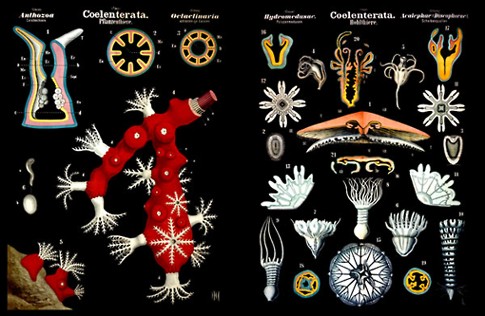
Acalephae – Dal greco antico ἀκαλήφη (akalëphë, ortica). Sinonimo: ortiche di mare. Un gruppo di Celenterati chiamato ortiche di mare dal loro pungiglione.
Acalephae – From ancient Greek ἀκαλήφη (akalëphë, nettle). Synonyms: sea nettles. A group of Coelenterata called sea nettles from their sting.

A
Abyla
– nom. propr. – Diphyidae
Abila latino / Latin – Ἀβίλη
/ Ἀβύλη
Abílë / Abýlë greco / Greek = Abila:
promontorio della Mauritania, la più meridionale delle Colonne d'Ercole,
quella europea era Calpe. – Abyla: promontory of Mauritania opposite to the
Rock of Gibraltar (Calpe), one of the Pillars of Hercules.
Acalephae – ἀκαλήφη,
urtica – Nomen Classis
akalëphë = ortica – nettle § Le meduse dette anche acalefe (ortica)
perché irritano la pelle – The jellyfishes are also called acalephae (nettles)
from the stinging power they possess.
Acies – nom. propr. – Velellidae
acies = punta – point
Acils – sine ciliis – Acalephae
sine ciliis = senza ciglia – without eyelashes
Aegina –
αἰγίς,
pellis caprina – Thalassantheae
aigís = pelle di capra – hide of goat
Aeginopsis – aegina; ὄψις,
aspectus – Thalassantheae
aegina = αἰγίς,
aigís = pelle di capra – hide of goat; ópsis = aspetto – appearance
Aequorea / Aequoridae
– aequor – Aequoridae / Discophorae
aequor = superficie piana e liscia – flat and smooth surface
Agalma / Agalmae
/ Agalmidae
– ἄγαλμα,
ornamentum – Physophoridae / Siphonophorae
ágalma = ornamento – ornament
Aglaia – nom. mythol. – Diphyidae
Aglaia = Aglaia, la più giovane delle Grazie –
Aglaea, the youngest of the Charites
Aglaisma – ἀγλάϊσμα,
ornamentum – Diphyidae
agláïsma = ornamento – ornament
Aglaura
– ἄγλαυρος,
splendens – Nucleiferae
áglauros = splendente – shining
Alcynoë – nom. propr. – Mnemiidae
Alcynoë – Ἀλκινόη
Alkinøë = Alcinoe: figlia di Polibo re di
Corinto / una delle ninfe che allevarono Zeus – Alcinoe: daughter of Polybus
king of Corinth / one of the nymphs nursing Zeus.
Alophota /
Alophotae
– ἀ-
priv.; λόφος,
crista – Physophoridae
alpha privativa / privative = senza – without;
lóphos = ciuffo, cresta – tuft, comb
Amphirea – ἀμφί,
circum; ῥέω,
fluo – Diphyidae
amphí = intorno – around; rhéø = io scorro – I flow
Anais –
nom. propr. – Beroidae
etimologia introvabile – untraceable etymology
Angela –
nom. propr. – Physophoridae
angela = angela – angel (feminine)
Anthophysa
/ Anthophysidae
– ἄνθος,
flos; φῦσα,
pustula – Physophoridae
ánthos = fiore – flower; phûsa = pustola – pimple
Apolemia / Apolemiae
– ἀπόλεμος,
pacificus – Physophoridae
apólemos = pacifico – peaceful
Apolemiopsis – ἀπόλεμος,
pacificus; ὄψις,
aspectus – Physophoridae
apólemos = pacifico – peaceful; ópsis = aspetto – appearance
Appendicularia
– appendix – Beroidae
appendix = appendice – appendix
Arachnoderma – ἀράχνη,
aranea; δέρμα,
cutis – Acalephae
aráchnë = ragnatela – spiderweb; dérma = pelle
– skin
Arethusa – nom. mythol. –
Physophoridae
Arethusa = Aretusa: sacra sorgente dell'antica Siracusa e ninfa abitatrice
della sorgente – Arethusa: sacred source of the ancient Sicilian Syracuse
and nymph dweller of the source.
Aristerodexia –
ἀριστερός,
sinister; δεξιά,
dextera manus – Physophoridae
aristerós = sinistro – left; dexiá = mano destra – right hand
Astoma / Astomae
– ἀ-
priv.; στόμα,
os – Medusidae
alpha privativa / privative = senza – without; stóma = bocca – mouth
Athorybia – ἀθόρυβος,
tranquillus – Physophoridae
athórybos = tranquillo – quiet
Aurelia
– nom. propr. – Medusidae
Aurelia = l'imperatrice romana Annia Galeria Aurelia Faustina (Roma 125 –
Habala, Cappadocia, 176) / Annia Galeria Aurelia Lucilla (Roma 150 – Capri
182) – the Roman Empress Annia Galeria Aurelia Faustina (Rome 125 – Habala,
Cappadocia, 176) / Annia Galeria Aurelia Lucilla (Rome 150 – Capri 182)
Axia – ἀξία,
dignitas – Mnemiidae
axía = dignità – dignity
Axiotima
– ἀξιότιμος,
pretiosus – Mnemiidae
axiótimos = prezioso – precious
B
Bassia
– nom. propr. – Acalephae – Diphyidae
etimologia introvabile – untraceable etymology
Berenix / Berenice / Berenicidae –
nom. propr. – Berenicidae / Discophorae
Berenix = etimologia introvabile – untraceable etymology § Anticamente c’erano
molte città che traevano il loro nome da quello di cui si ornavano molte
regine e principesse di Oriente e d’Africa: Berenice, in latino Berenix.
Berenice è di per sé stesso un nome augurale, foggiato con due parole
greche, e significa esattamente portatore di vittoria. Piaceva molto in
antico (...) e le città che se ne fregiavano erano, come s’è detto,
parecchie, tra cui una in Cirenaica, oggi Bengasi. (Aldo Gabrielli)
Beroe / Beroides / Beroidae / Beroae / Beroidae / Beroideae
– nom. propr. – Beroidae
Βερόη
Beróë – Beroe = Beroe nella mitologia
greca era il nome di diverse figure mitologiche – Beroe is the name of
various Greek mythological figures.
Berosoma –
Beroe; σῶμα,
corpus – Beroidae
Βερόη
Beróë – Beroe = Beroe nella mitologia
greca era il nome di diverse figure mitologiche – Beroe is the name of
various Greek mythological figures; sôma = corpo – body
Biblis – βιβλίς,
funis papyraceus – Medusidae
biblís = corda di papiro – rope of papyrus
Bipinnaria –
bis; pinna – Beroidae
bis = due volte – twice; pinna = pinna – fin
Bougainvillia –
Bougainville – Nucleiferae
Bougainville = Louis Antoine, conte di Bougainville (Parigi, 12 novembre 1729
– Parigi, 31 agosto 1811) è stato un esploratore, navigatore, ammiraglio e
matematico francese. Bougainville è una delle più grandi isole
dell'arcipelago delle Isole Salomone nel sud-ovest dell’Oceano Pacifico. –
Louis-Antoine, Comte de Bougainville (12 November 1729 – 31 August 1811) was
a French admiral and explorer. Bougainville Island is the main island of the
Autonomous Region of Bougainville of Papua New Guinea. This region is also
known as Bougainville Province or the North Solomons.
Brachysoma
– βραχύς,
brevis; σῶμα,
corpus – Physophoridae
brachýs = corto – short; sôma = corpo – body
Bucephalon = βοῦς,
bos; κεφαλή,
caput – Mnemiidae
boûs = bue – ox; kephalë = testa – head
Bursarius –
bursa – Marsupialidae
bursa = otre – leather bag
C
Callianira
/ Callianiridae – nom. propr. – Callianiridae
Callianira, una delle Nereidi, ninfe marine della mitologia greca –
Callianeira, one of the Nereids, sea nymphs of Greek mythology
Callirhoe – nom. mythol. – Medusidae
Calliroe, una delle Oceanine, figlie del Titano Oceano e della Titanide Teti
– Callirrhoe in Greek mythology was the daughter of Oceanus and Tethys.
Calpe – κάλπη,
urna – Diphyidae
kálpë = urna – urn
Calymma – κάλυμμα,
tegmen – Mnemiidae
kálymma = copertura – cover
Campanella – campana – Marsupialidae
campana = campana – bell
Carybdea / Carybdeae – χάρυβδις,
vortex – Carybdeae
chárybdis = vortice – whirl
Cassiopea – nom. mythol. – Rhizostomidae
Cassiopea è una figura della mitologia greca, una delle cinquanta Nereidi, le
ninfe del mare figlie di Nereo. – Cassiopeia is one of the fifty Nereids,
the nymph-daughters of the sea god Nereus.
Cephea – nom. propr. – Rhizostomidae
La leggenda ci tramanda due Cefea: uno fu un re di Tegea in Arcadia ed è
legato alla leggenda di Eracle. L'altro è un figlio di Belos, padre di
Andromeda e marito di Cassiopea. Regnò sui Cefeni, un popolo che si colloca
alle volte nella regione dell'Eufrate e altre volte in Etiopia.
Cestum – κεστός,
cestus – Callianiridae
kestós = cintura – belt
Chrysaora – χρυσός,
aurum; ἄορ,
gladius – Medusidae
chrysós = oro – gold; áor = spada – sword
Circe – nom. mythol. – Nucleiferae
Circe è una dea della religione greca. Compare nell'Odissea di Omero (libro
X, XI e XII) e nel mito degli Argonauti. – In Greek mythology, Circe is a
minor goddess of magic (or sometimes a nymph, witch, enchantress or sorceress),
described in Homer's Odyssey as "The loveliest of all immortals".
Claustra – claustrum – Medusidae
claustrum = serratura – lock
Conis – κόνις,
cinis – Nucleiferae
kónis = cenere – ash
Cryptocarpae – κρυπτός,
occultus; καρπός,
fructus – Discophorae
kryptós = nascosto – hidden; karpós = frutto –
fruit
Ctenophorae – κτείς,
pecten; φορέω,
fero – Acalephae
kteís = pettine – comb; phoréø = io porto – I carry
Cuboides – κύβος,
cubus – Diphyidae
kúbos = cubo – cube
Cucubalus – nom. propr. – Diphyidae
cucubalus = cuculus = cuculo – cuckoo
Cucullus – nom. propr. – Diphyidae
cucullus = cappuccio – hood
Cuneolaria – cuneolus – Physophoridae?
cuneolus = piccolo cuneo – little wedge
Cunina – nom. propr. – Thalassantheae
Nella mitologia romana, Cunina era un divinità indigena che si prendeva cura
dei bambini nella culla. – In the Roman mythology, Cunina was a local deity
that took care of the children in the cradle.
Cupulita – cupula – Physophoridae
cupula = piccola botte – little barrel
Cuvieria – Cuvier – Berenicidae
Georges Leopold Chretien Frédéric Dagobert Cuvier (Montbéliard, 23 agosto
1769 – Parigi, 13 maggio 1832) è stato un biologo francese. – Georges
Chrétien Léopold Dagobert Cuvier or Jean Léopold Nicolas Frédéric Cuvier
(sources differ on his name) (August 23, 1769 – May 13, 1832), known as
Georges Cuvier, was a French naturalist and zoologist.
Cyanaea / Cyanea – κυάνεος,
coeruleus – Medusidae
kyáneos = azzurro cupo – dark blue
Cyaneopsis – κυάνεος,
coeruleus; ὄψις,
facies – Medusidae
kyáneos = azzurro cupo – dark blue; ópsis = aspetto – appearance
Cydalisia – nom. propr. – Beroidae
parola introvabile – untraceable word
Cydippe – nom. mythol. – Callianiridae
Cidippe era la madre di Cleobi e Bitone. / Cidippe era la figlia di Egetoria
ed Ochimo. – Cydippe was the mother of Cleobis and Biton. / Cydippe or
Cyrbia was the daughter of Hegetoria and Ochimus.
Cymba – nom. propr. – Diphyridae
cymba = barchetta – little boat
Cytaeis – nom. mythol. – Marsupialidae
Κυταιεύς,
Kytaieús: la donna di Citea (Kýtaia in greco, città della Colchide) è
Medea, la maga per antonomasia.
D
Dianaea
– Diana – Geryonidae
Diana, nella mitologia romana, era la dea della caccia e della luna, figlia di
Giove e di Latona, sorella di Apollo. – In Roman mythology, Diana was the
goddess of the hunt, the moon and birthing, being associated with wild animals
and woodland, and having the power to talk to and control animals.
Dichlostoma / Diclostoma – δικλίς,
claustrum duplex; στόμα,
os – ?
diklís = chiusura a due battenti – double fastener; stóma = bocca –
mouth
Diphyes / Diphydes / Diphyidae / Diphydae – διφυής,
duplicis naturae – Diphyidae / Siphonophorae / Physophoridae / Acalephae
diphyës = di doppia natura – of double nature
Diphyomorpha – διφυής,
duplicis naturae; μορφή,
forma – Diphyidae
diphyës = di doppia natura – of double nature; morphë = forma – shape
Diphysa – δίς,
bis; φῦσα,
pustula – Physophoridae
dís = due volte – twice; phûsa = pustola, vescichetta – pimple, vesicle
Diplocraspedon – διπλόος,
duplex; κράσπεδον,
limbus – Medusidae
diplóos = duplice – twofold; kráspedon = orlo – border
Discolabe / Discolabae – δίσκος,
discus; λαβή,
ansa – Physophoridae
dískos = disco – disc; labë = manico, ansa – handle
Discophorae – δίσκος,
discus; φορέω,
fero – Acalephae
dískos = disco – disc; phoréø = io porto – I carry
Discus – nom. propr. – Eudoreae
discus = disco – disc
Dodecabostrycha – δωδεκάς,
duodecim; βόστρυχος,
cirrus – Diphyidae
dødekás = dozzina – dozen; bóstrychos = ricciolo – curl
Doliolum – nom. propr. – Eudoreae
doliolum = botticella – little barrel
Dubreuillia – Dubreuil – ?
Dubreuil = persona introvabile – untraceable person
E
Eirene
– nom. propr. – Geryonidae
Eirene o Irene nella mitologia greca era la dea della pace, di cui costituisce
la personificazione. Figlia di Zeus e di Temi era una delle Ore. Il
corrispondente nella mitologia romana era Pax. – Eirene, or Irene, one of
the Horae, was the personification of peace, and was depicted in art as a
beautiful young woman carrying a cornucopia, sceptre and a torch or rhyton.
She is said sometimes to be the daughter of Zeus and Themis.
Elephantopes
– elephas; pes – Physophoridae
elephas = elefante – elephant; pes = zampa – leg
Enneagonum
– ἐννέα,
novem; γωνία,
angulus – Diphyidae
ennéa = nove – nine; gønía = angolo – angle, corner
Ephyra –
nom. mythol. – Eudoreae
Efira era una delle Oceanine oppure una delle Nereidi – Ephyra was one of
the Oceanids or one of the Nereids.
Epibulia
– ἐπίβουλος,
insidiosus – Physophoridae
epíboulos = insidioso – insidious
Epomis –
ἐπωμίς,
interula – Beroidae
epømís = spalla – shoulder; interula = camicia – shirt
Ersaea / Hersaea
– ἑρσαείς,
roratus – Diphyidae
hersaeís = rugiadoso – dewy
Eschscholtzia
– Eschscholtz – Clallianiridae
Eschscholtz = Johann Friedrich Ludwig Heino Ottkar Wolfram Franz von Assisi
Waldemar von Eschscholtz (Dorpat, 1º novembre 1793 – Mosca, 19 maggio 1831)
è stato un fisico, botanico e zoologo tedesco. – Johann Friedrich
Eschscholtz (November 1, 1793 – May 19, 1831) was a Livonian physician,
botanist, zoologist and entomologist of Baltic German lineage.
Eucharis
– εὔχαρις,
venustus – Mnemiidae
eúcharis = grazioso – pretty
Eucoelium
– εὖ,
bene; κοιλία,
cavum – ?
eû = bene – well; koilía = cavità – hollow
Eudora / Eudoreae
– εὔδωρος,
liberalis – Eudoreae / Discophorae
eúdøros = generoso – generous
Eudorae
– Eudora – Eudoreae
Eudora = Eudora, una delle Iadi della mitologia greca – Eudora, one of the
Hyades in Greek mythology; Eudora = Eudora = generoso – generous
Eudoxia
– nom. propr. (εὐδοξία)
– Diphyidae
Eudoxía = Licinia Eudossia (Costantinopoli, 422 – Costantinopoli, 462
circa) fu augusta dell'Impero romano d'Occidente, figlia dell'imperatore
d'Oriente Teodosio II e moglie dell'imperatore d'Occidente Valentiniano III.
– Licinia Eudoxia (422–462) was a Roman Empress, daughter of Eastern
Emperor Theodosius II and wife of the Western Emperors Valentinian III and
Petronius Maximus. – eudoxía = fama – fame
Eulymena /
Eulymenes
– nom. propr. – Eudoreae
Eulimene = una Nereide – one of the Nereids
Euryale
– εὐρύαλος,
late areatus – Eudoreae
eurýalos = ampio – wide
Eurybia
– nom. propr. (εὐρυβίας)
– Aequoridae
eurybías = molto forte – very strong
Evagora
– nom. propr. – Medusidae
Evagora, figlio di Nicocle, fu re di Salamina e di Cipro nel IV secolo aC. –
Evagoras was the king of Salamis (410 – 374 BC) in Cyprus.
F
Favonia
– nom. propr. – Geryonidae
favonia = etimologia introvabile – untraceable etymology
Foveolia – nom. propr. – Thalassantheae
foveolia = etimologia introvabile – untraceable etymology
Fretillaria – fretum – Beroidae
fretum = stretto di mare – strait of sea
G
Galeolaria
– galeola – Diphydae
galeola = vaso da vino – pot for wine
Geryonia / Geryonidae / Gergonia – Geryon (nom. mythol.)
– Geryonidae
Geryon = Gerione è una figura della mitologia greca, figlio di Crisaore e di
Calliroe, e fratello di Echidna. Era un fortissimo gigante con tre teste, tre
busti e due sole gambe, proprietario d'un regno esteso fino ai confini della
mitica Tartesso. – Geryon in Greek mythology was often described as a
monster with human faces. According to Hesiod, Geryon had one body and three
heads, whereas the tradition followed by Aeschylus gave him three bodies.
Gleba – nom. propr. – Physophoridae?
gleba = zolla di terra – clod of earth
H
Heccaedecabostrycha
– ἑκκαίδεκα,
sexdecim; βόστρυχος,
cirrus – Medusidae
hekkaídeka = sedici – sixteen; bóstrychos = ricciolo – curl
Heccaedecomma – ἑκκαίδεκα,
sexdecim; ὄμμα,
oculus – Medusidae
hekkaídeka = sedici – sixteen; ómma = occhio – eye
Hippocrene – nom. mythol. – Nucleiferae
Hippocrene = Ippocrene, fonte sacra alle Muse sull'Elicona, fatta sprizzare
dal cavallo Pegaso con un colpo di zampa. – In Greek mythology, Hippocrene
was the name of a fountain on Mt. Helicon. It was sacred to the Muses and was
formed by the hooves of Pegasus.
Hippopodius – ἵππος,
equus; ποῦς,
pes – Physophoridae
híppos = cavallo – horse; poûs = zampa – leg
I
Idya
– nom. propr. – Beroidae
Idya = etimologia introvabile – untraceable etymology
J
Janira
– nom. propr. – Beroidae
Janira = etimologia introvabile – untraceable etymology
L
Laodicea
– nom. mythol. – Nucleiferae
Laodicea = Laodicea fu il nome di almeno 7 diverse città nel regno seleucide.
– Laodicea has been the name of at least 7 different towns in Seleucid
Empire.
Lemniscus – nom. propr. – Beroidae
lemniscus = nastro – ribbon
Lesueuria – Lesueur – Beroidae
Lesueur = Charles Alexandre Lesueur (Le Havre, 1º gennaio 1778 –
Sainte-Adresse, 12 dicembre 1846) è stato un naturalista, esploratore e
pittore francese. – Charles Alexandre Lesueur (1 January 1778 in Le Havre
– 12 December 1846 in Sainte-Adresse) was a French naturalist, artist and
explorer.
Leucothoea / Leucothoeae – λευκός,
albus – Beroidae
leukós = bianco – white
Linuche – λινοῦχος,
retiarius – Geryonidae
linoûchos = parola introvabile – untraceable word; retiarius = gladiatore
armato di tridente e di rete – gladiator armed with three-pronged fork and
net
Liriope – nom. mythol. – Geryonidae
Liriope = Lirìope nella mitologia greca era il nome di una delle Naiadi
(ninfe delle acque dolci) che viveva nella Focide. Un giorno fu imprigionata
fra le onde del dio fluviale Cefiso e da questi violentata. Rimasta incinta,
diede alla luce un bellissimo bambino che chiamò Narciso. – In Greek
mythology, Liriope or Leiriope is a Boeotian naiad, who was probably the
daughter of one of the Boeotian or Phocian river Gods. Liriope was loved by
the river-god Cephissus, who was himself the son of Oceanus and Tethys, and
bore his son Narcissus.
Lymnorea – λίμνη,
aestuarium; ῥέω,
fluo – Geryonidae
límnë = stagno – pond; rhéø = io scorro – I flow
M
Macrosoma
– μακρός,
longus; σῶμα,
corpus – Physophoridae
makrós = lungo – long; sôma = corpo – body
Marsupialis / Marsupialidae / Marsupialae – marsupium
– Marsupialidae / Medusidae
marsupium = tasca, borsa – pocket, bag
Medea – nom. mythol. – Beroidae
Medea è una figura della mitologia greca, figlia di Eete, re della Colchide,
e di Idia. Era inoltre nipote di Elio (secondo altre fonti di Apollo) e della
maga Circe, e come quest'ultima era dotata di poteri magici. – In Greek
mythology, Medea was the daughter of King Aeëtes of Colchis, niece of Circe,
granddaughter of the sun god Helios, and later wife to the hero Jason, with
whom she had two children, Mermeros and Pheres.
Medusa / Medusariae / Medusidae / Medusae – nom.
mythol. – Acalephae / Discophorae
Medusa = Medusa è un creatura mostruosa appartenente alla mitologia greca.
Insieme a Steno (la forte) ed Euriale (colei che salta lontano) era una delle
tre Gorgoni, figlie di Forco e di sua sorella Ceto, due orrendi mostri marini,
e l'unica a non essere immortale. – In Greek mythology Medusa was a monster,
a Gorgon, generally described as having the face of a hideous human female
with living venomous snakes in place of hair.
Melicerta / Melicertum – nom. mythol. – Geryonidae /
Nucleiferae
Melicerta = Melicerte è una figura della mitologia greca, figlio di Atamante
e di Ino, fratello di Learco. La dea Era fece impazzire Atamante e Ino,
poiché allevarono Dionisio come se fosse una femmina. Atamante, impazzito,
mentre cacciava, scambiò il figlio maggiore, Learco, per un cervo e lo
uccise. La moglie, disperata, buttò Melicerte in un calderone bollente e poi
si gettò con lui in mare. – In Greek mythology, Melicertes is the son of
the Boeotian prince Athamas and Ino, daughter of Cadmus.
Melitea – nom. propr. – Medusidae
Melitea forse / perhaps = Melite è una Naiade. / Melite è un personaggio
della mitologia greca, figlia di Poseidone e ninfa di Corcira. Si unì a
Eracle, il quale era stato esiliato nell'isola di Scheria per via
dell'uccisione dei suoi figli. Ella gli diede un figlio di nome Illo –
Melite was one of the Naiads, daughter of the river god Aegaeus, and one of
the many loves of Zeus and his son Heracles..
Mertensia – Mertens – Callianiridae
Mertens = persona introvabile – untraceable person
Mesonema – μέσος,
medius; νῆμα,
filum – Oceanidae
mésos = intermedio – in-between; nêma = filo – yarn
Microstoma – μικρός,
parvus; στόμα,
os – Nucleiferae
mikrós = piccolo – small; stóma = bocca – mouth
Mitra – nom. propr. – Marsupialeae
mitra = cintura, turbante – belt, turban
Mnemia / Mnemiidae – μνῆμα?
monumentum – Mnemiidae / Ctenophorae
forse da / perhaps from mnêma = monumento funebre – tomb
Monocraspedon – μόνος,
unicus; κράσπεδον,
limbus – Medusidae
mónos = unico – one and only; kráspedon = orlo – border
Monogastricae – μόνος,
unicus; γαστήρ,
venter – Diphyidae
mónos = unico – one and only; gastër = ventre – venter
Monostomae – μόνος,
unicus; στόμα,
os – Discophorae
mónos = unico – one and only; stóma = bocca – mouth
N
Navicula
– navis – Diphyidae
navis = nave – ship
Neis / Neidae / Neisidae – Neis (nom. propr.) –
Callianiridae / Beroidae
Neis = etimologia introvabile – untraceable etymology
Noctiluca – nox; luceo – Diphyidae
nox = notte – night; luceo = io risplendo – I shine
Nucleiferae – nucleus; fero – Discophorae
nucleus = nucleo – nucleus; fero = io porto – I carry
O
Obelia
– ὀβελός,
hasta – Carybdeae
obelós = spiedo, asta – spit, staff
Oceania / Oceanidae – oceanus – Oceanidae / Discophorae
oceanus = oceano – ocean
Ocyroe / Ocyroeae – ὠκυρόης,
rapide fluens – Rhizostomidae / Beroidae
økyróës = che scorre veloce – quickly flowing
Oikopleura – οἶκος,
domus; πλευρά,
costa – Beroidae
oîkos = casa – home; pleurá = costa, fianco – rib, flank
Orythia – nom. mythol. – Geryonidae
Orythia = Orizia (o Oritia) è una figura della mitologia greca, figlia del re
Eretteo e di Prassitea, e aveva diverse sorelle, tra cui Creusa, Ctonia e
Procri. – Orithyia was the daughter of King Erechtheus of Athens and his
wife, Praxithea, in Greek mythology. Her brothers were Cecrops, Pandorus, and
Metion, and her sisters were Procris, Creusa, and Chthonia.
P
Pandea
– nom. propr. – Nucleiferae
etimologia introvabile – untraceable etymology
Pandora – nom. mythol. – Beroidae
Pandora = Pandora nella mitologia greca è la prima donna, creata su ordine di
Zeus, per punire l'umanità. – In Classical Greek mythology dating to Hesiod,
Pandora was the first human woman created by the deities, specifically by
Hephaestus and Athena on the instructions of Zeus.
Patera – nom. propr. – Oceanidae
patera = tazza – cup
Pegasia – nom. mythol. – Thalassantheae
Pegasia = Pegaso è una figura della mitologia greca. È il più famoso dei
cavalli alati. – Pegasus is one of the best known mythological creatures in
Greek mythology. He is a winged divine stallion usually depicted as pure white
in colour.
Pelagia – πελάγιος,
marinus – Medusidae
pelágios = marino – marine
Phacellophora – φάκελλος,
fasciculus; φορέω,
fero – Medusidae
phákellos = fascio – bundle; phoréø = io porto – I carry
Phanerocarpae – φανερός,
manifestus; καρπός,
fructus – Discophorae
phanerós = manifesto – manifest; karpós = frutto – fruit
Phorcynia – nom. mythol. – Eudoreae
Phorcynia = Forco, conosciuto anche come Forci o Forcide, è una divinità
primordiale della mitologia greca che rappresenta i pericoli nascosti nelle
profondità marine. – In Greek mythology, Phorcys is a god of the hidden
dangers of the deep. He is a primordial sea god, generally cited (first in
Hesiod) as the son of Pontus and Gaia.
Phyllodoce – φύλλον,
folium; δοκός,
tignum – Physophoridae
phýllon = foglia – leaf; dokós = trave – beam
Physalia / Physalis / Physalidae – φυσαλλίς,
pustula – Physophoridae / Siphonophorae
physallís = pustola – pustule
Physematium – φύσημα,
tumor – Diphyidae
phýsëma = gonfiore
– swelling
Physograda – φῦσα,
vesica; gradus – Physophoridae
phÿsa = vescichetta – blister; gradus = grado – degree
Physophora / Physophorae / Physophoridae – φῦσα,
vesica; φορέω,
fero – Physophoridae / Siphonophorae
phÿsa = vescichetta – blister; phoréø = io porto – I carry
Pileola – pileolus – Eudoreae
pileolus = piccolo pileo, berrettino – small pileus, small cap
Piliscelotus – πῖλος,
pilus; σκέλος,
crus – Oceanidae
pîlos = cappello – hat; skélos = zampa – leg
Plethosoma / Plethosomae – πλῆθος,
magnitudo; σῶμα,
corpus – Physophoridae
plêthos = grandezza – bigness; sôma = corpo – body
Pleurobrachia – πλευρά,
latus; βραχίων,
brachium – Callianiridae
pleurá = lato – side; brachíøn = braccio – arm
Polybostricha / Polybostrycha – πολύς,
multus; βόστρυχος,
cirrus – Medusidae
polýs = molto – very; bóstrychos = ricciolo – curl
Polybrachionia – πολύς,
multus; βραχίων,
brachium – Velellidae
polýs = molto – very; brachíøn = braccio – arm
Polyclonia – πολύς,
multus; κλόνος,
agitatio – Rhizostomidae
polýs = molto – very; klónos = agitazione – agitation
Polygastricae – πολύς,
multus; γαστήρ,
venter – Diphyidae
polýs = molto – very; gastër = ventre – venter
Polyptera – πολύς,
multus; πτερόν,
penna – Mnemiidae
polýs = molto – very; pterón = pinna – fin
Polystomae – πολύς,
multus; στόμα,
os – Discophorae
polýs = molto – very; stóma = bocca – mouth
Polytoma / Polytomae – πολύς,
multus; τομή,
sectio – Physophoridae / Acalephae
polýs = molto – very; tomë = taglio – cutting
Polytomus – πολύς,
multus; τόμος,
pars – Physophoridae
polýs = molto – very; tómos = parte – part
Polyxenia – nom. mythol. – Aequoridae
Polyxenia = Polissena è una delle figlie di Priamo e di Ecuba, principessa
troiana di mirabile bellezza. La si ritiene responsabile della vaticinata e
precoce uccisione di Achille, eroe mitico di proverbiale coraggio. – In
Greek mythology, Polyxena was the youngest daughter of King Priam of Troy and
his queen, Hecuba. She is considered the Trojan version of Iphigenia, daughter
of Agamemnon and Clytemnestra.
Pontocardia – πόντος,
mare; καρδία,
cor – Physophoridae
póntos = mare – sea; kardía = cuore – heart
Porpita / Porpitinae / Porpitae / Porpitidae – πόρπη,
fibula – Velellidae / Siphonophorae
pórpë = fibbia – buckle
Praia – vox barbara – Diphyidae
parola straniera – foreign word § portoghese / Portuguese praia = spiaggia
– beach
Proboscidactyla – προβοσκίς,
proboscis; δάκτυλος,
digitus – Geryonidae
proboskís = proboscide – proboscis; dáktylos = dito – finger, toe
Protomedea – πρῶτος,
primus; Medea – Physophoridae
prôtos = primo – first; Medea = Medea è una figura della mitologia greca,
figlia di Eete, re della Colchide, e di Idia. – In Greek mythology, Medea
was the daughter of King Aeëtes of Colchis, niece of Circe, granddaughter of
the sun god Helios, and later wife to the hero Jason, with whom she had two
children, Mermeros and Pheres.
Pterolyra – πτερόν,
ala; λύρα,
lyra – ?
pterón = pinna – fin; lýra = lira – lyre
Pulmograda – pulmo; gradus – Acalephae
pulmo = polmone – lung; gradus = grado – degree
Pyramis – nom. propr. – Diphyidae
pyramis = piramide – pyramid
R
Racemis
– racemus – Physophoridae
racemus = grappolo – bunch, cluster
Rataria – nom. propr. – Velellidae
Rataria = etimologia introvabile – untraceable etymology
Rathkia – Rathke – Oceanidae
Rathke = Martin Heinrich Rathke, medico (Danzica 1793 - Königsberg 1860),
professore di fisiologia e di patologia generale nell'università di Dorpat
(1829-35), poi (dal 1835) di zoologia e di anatomia a Königsberg. – Martin
Heinrich Rathke (August 25, 1793 – September 3, 1860) was a German
embryologist and anatomist.
Ratis – nom. propr. – Velellidae
ratis = zattera – raft
Rhizophysa / Rhizophysae / Rhizophysidae
– ῥίζα,
radix; φῦσα,
vesica – Diphyidae / Physophoridae
rhíza = radice – root; phÿsa = vescichetta, vescica – blister, bladder
Rhizostoma / Rhizostomidae – ῥίζα,
radix; στόμα,
os – Rhizostomidae / Discophorae
rhíza = radice – root; stóma = bocca – mouth
Rhodophysa – ῥόδον,
rosa; φῦσα,
pustula – Physophoridae
rhódon = rosa – rose; phÿsa = pustola – pustule
Rosacea – rosa – Diphyidae
rosa = rosa – rose
S
Salacia
/ Salaciae – nom. mythol. – Physophoridae
Salacia = Salacia è un'antichissima dea marina della mitologia romana, dea
dell'acqua salata e custode delle profondità dell'oceano come affermato da
Apuleio ne Le metamorfosi. Fu sposa e regina di Nettuno, dio del mare e
dell'acqua. Nella mitologia greca veniva identificata come Anfitrite, moglie
di Poseidone, ed era una delle Nereidi. – In ancient Roman mythology,
Salacia was the female divinity of the sea, worshipped as the goddess of salt
water who presided over the depths of the ocean. She was the wife and queen of
Neptune, god of the sea and water. That Salacia was the wife of Neptune is
implied by Varro, and is positively affirmed by Seneca, Augustine and Servius.
Salamis – nom. mythol. – Medusidae
Salamis = Salamina, personaggio della mitologia greca, figlia di Asopo e
Metope. – Salamis, a daughter of Asopus, and by Poseidon the mother of
Cenchreus or Cychreus.
Saphenia – σαφήνεια,
puritas – Geryonidae
saphëneia = purezza – purity
Sarcoconus – σάρξ,
caro; γόνος,
proles – Physophoridae
sárx = carne – flesh; gónos = prole – offspring
Sarsia – Sars – Medusidae
Sars = Georg Ossian Sars (Kind, 20 aprile 1837 – Oslo, 9 aprile 1927) è
stato uno zoologo norvegese. – Georg Ossian Sars (April 20, 1837 – April
9, 1927) was a Norwegian marine and freshwater biologist.
Scyphis – σκύφος,
scyphus – Marsupialeae
skýphos = tazza – cup
Siphonophorae – σίφων,
sipho; φορέω,
fero – Acalephae
síphøn = sifone – siphon; phoréø = io porto – I carry
Slabberia – Slabber – Medusidae
Slabber = Slabber Martinus 1741?-1835
Sophia – nom. propr. – Callianiridae
sophia = sapienza – wisdom
Staurophora – σταυρός,
crux; φορέω,
fero – Berenicidae
staurós = croce – cross; phoréø = io porto – I carry
Stephanomia / Stephanomiae – στέφανος,
corona – Physophoridae
stéphanos = corona – crown
Sthenonia – σθένος,
robur – Medusidae
sthénos = forza – strength
Stomobrachiota / Stomobrachium – στόμα,
os; βραχίων,
brachium – Oceanidae
stóma = bocca – mouth; brachíøn = braccio – arm
Strobila – strobilus (Aurelia aurita iuv.) – Medusidae
strobilus = pigna – pine cone
Sulculearia / Sulculeolaria – sulcus – Diphyidae
sulcus = solco – furrow
T
Tetragona
– τετράς,
quatuor; γόνυ,
genu – Diphyidae
tetrás = quattro – four; góny = ginocchio –
knee
Tetragonum – τετράς,
quatuor; γωνία,
angulus – Diphyidae
tetrás = quattro – four; gønía = angolo –
angle, corner
Thalassanthae – θάλασσα,
mare; ἄνθος,
flos – Oceanidae
thálassa = mare – sea; ánthos = fiore – flower
Thalassantheae – θάλασσα,
mare; ἄνθος,
flos – Discophorae
thálassa = mare – sea; ánthos = fiore – flower
Thalia – nom. mythol. – Physophoridae
Thalia = Talìa è una figura della mitologia greca. È una delle Muse, figlia
di Zeus e Mnemosine colei che presiede alla commedia. È ritenuta la madre dei
Coribanti avuti da Apollo. – Thalia was the Muse who presided over comedy
and idyllic poetry. In this context her name means "flourishing",
because the praises in her songs flourish through time. She was the daughter
of Zeus and Mnemosyne, the eighth-born of the nine Muses.
Thaumantias – θαῦμα,
miraculum – Geryonidae
thaûma = cosa meravigliosa – marvel
Tholus – nom. propr. – Nucleiferae
tholus = edificio circolare, cupola – circular building, dome
Tiara – nom. propr. – Nucleiferae
tiara = tiara – tiara
Tima – nom. propr. – Geryonidae
tima = parola introvabile – untraceable word
Trianisites – τρίς,
ter; ἄνισος,
inaequalis – ?
trís = tre volte – thrice; ánisos = disuguale
– unequal
Turris – nom. propr. – Nucleiferae
turris = torre – tower
V
Velella
/ Velellidae / Velellinae / Velellae – nom. propr. –
Velellidae / Siphonophorae / Acalephae
velella = dal latino velum, velo o vela – from Latin velum, a veil, a sail
§ Velella velella, la barchetta di San Pietro, spesso viene ritrovata sulle
rive (o al massimo a 1-2 cm di profondità nell'acqua) di tutti gli oceani,
con una preferenza per le acque calde o temperate. Come gli altri cnidari,
Velella velella è un animale carnivoro. A forma di dischetto ovale, del
diametro di 4-7 cm, sormontato da una cresta verticale che sembra una vela di
un minuscolo scafo (da cui appunto il nome "velella").– Velella is
a cosmopolitan genus of free-floating hydrozoans that live on the surface of
the open ocean. There is only one known species, Velella velella, in the genus.
Velella velella is commonly known by the names sea raft, by-the-wind sailor,
purple sail, little sail, or simply Velella. It is usually deep blue in colour,
but its most obvious feature is a small stiff sail that catches the wind and
propels them over the surface of the sea.
X
Xanthea
– ξανθός,
fulvus – Geryonidae
xanthós = biondo – fair
Z
Zygodactyla
– ζυγός,
iugum; δάκτυλος,
digitus – Oceanidae
zygós = giogo – yoke; dáktylos = dito – finger / toe
